Thursday, March 9, 2023

TCEA 2023

I have been an active member of CUE since 2015 and have attended numerous events affiliated with the organization.  For those unaware, CUE (formerly Computer Using Educators) is an organization formed in 1978 to further the use of technology in education and is based out of California, with affiliates all over the state, as well as Oregon and my home state, Nevada.  However, over the last few years, the organization has widened its scope into many more areas of education, including but not limited to leadership, equity, eSports, and more.  Another organization, similar in scope to CUE, is TCEA, the Texas Computer Education Association.  I have been wanting to attend their annual conference for a long time, and this year, I was finally able to do so! 

This year's conference was held in San Antonio, a city that I have always wanted to visit but had never had the opportunity.  When looking at the weather report in the days leading up to the conference, I packed for weather in the 50s and 60s with a slight chance of rain.  The day before the conference, a Sunday, I arrived to sunny skies, thick humidity due to a rainstorm earlier in the day, and a temperature near 80.  My instant thought was that I did not pack for warmer weather, but Monday morning brought me back to reality and then some.  

The colder weather "forced" me to go
buy a hat to keep my bald head warm!
For the remainder of the week, it was in the high 30s/low 40s and raining/ice (if you paid any attention to the news in early February, you saw that Texas was walloped with an epic ice storm that shut down cities like Dallas/Fort Worth, Austin, and to a lesser extent, San Antonio).  While not necessarily in town to sightsee, the weather impeded my ability to play tourist enough that even though the Alamo was two blocks from my hotel, the best that I did was stand in front of it (and didn't even take a picture because I thought I would be able to later in the week).  

So through a cold drizzle, I worked my way to the convention center on Monday morning for the opening of the conference.  I made sure to get there early just because of the sheer size of the convention center, hoping to get my bearings before sessions started and minimize the amount of time trying to find sessions.  I had done my homework ahead of time, selecting sessions and adding them to my calendar with locations so I could move between the sessions quickly.  I noticed right away a lot of things about the schedule that I really liked, especially in comparison to other conferences that I had attended in the past:

  • Session start times were staggered at half-hour intervals, allowing attendees to go to a session, figure out in the first few minutes if they wanted to stay, and if not, find another session to attend without having to wait nearly an hour for the next sessions to start
  • Rather than having keynote speakers, a series of "featured speakers" were scheduled for each day, much like a keynote. In addition, other sessions were scheduled during the featured speaker time if attendees didn't want to attend the "keynote"
  • Session lengths were varied, from 60, 90, 120, and 180 minutes; most conferences that I have attended tend to stick to the 60 minutes or less format, with a few exceptions
  • To enter a session, a conference volunteer scanned your badge before entering the room to ensure that there was still room in the session to sit.  If you're like me, you have walked into sessions only to find out that there wasn't any room, thus forcing you to leave
  • The convention hall was open on Sunday for attendees to check in, minimizing the amount of time needed on the opening morning, and sessions started as early as 7 AM and lasted until 5 PM starting on the first day, giving attendees an entire day of learning for 3 days, plus sessions that lasted until 2 PM on the fourth day
  • And while I did not partake in this particular feature, the exhibitor hall had a traveling beer cart where attendees could purchase a beverage to enjoy while checking out the various vendors and their products!
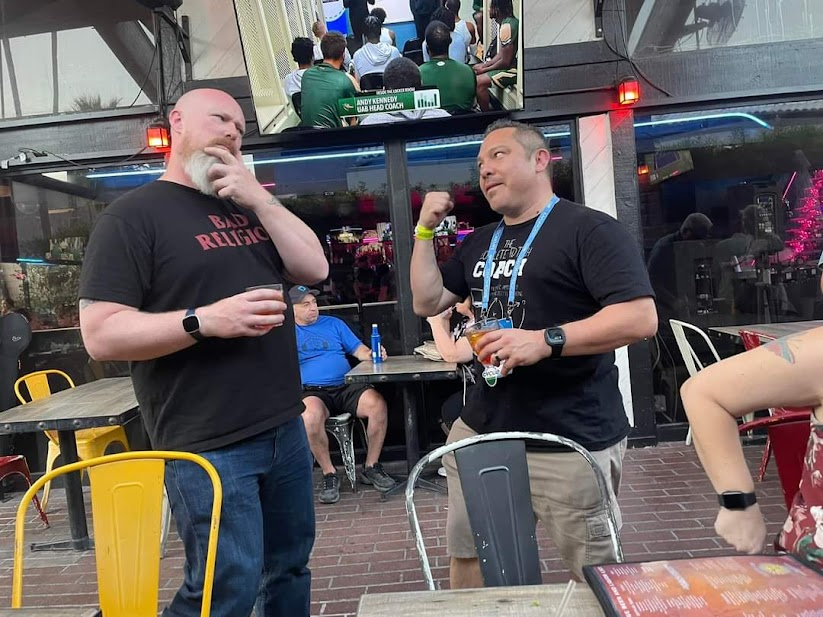
Clockwise from the left: me, Stevie
Frank, Debbie Tannenbaum, Andrea
Cook, Melody McAllister, and Jaki
Thomas enjoying the one day of 
decent weather!
Over the course of the four days, I attended a ton of sessions and checked out a variety of different products in the exhibitor hall.  However, like any conference, it was about human connections.  While I did not know a lot of people from previous interactions, there were still plenty of people that I had met before.  There were still more that I had been connected with on social media for a long time that I got to meet for the first time.  One such connection was with Stevie Frank, an educator from Indiana, that showed up at a restaurant on Sunday after I sent a tweet that I was having a drink and watching a band play, which I thought was really cool!  Then there are the people that I met for the first time without any previous connections,  including an educator from Dallas/Forth Worth named Dillon Johnston (@dillon_johnston on Twitter). 

I met Dillion standing on a street corner, freezing in the rain, waiting for the light to change on my way to find some lunch.  We got to chatting about our conference experience thus far and how we were braving the elements to find food that was not the typical convention center cafeteria food, especially me, since I wanted to experience some true San Antonio fare.  As the light changed, Dillon asked where I was heading, to which I responded that I was going to try a Tex-Mex place called Casa Rio.  Dillon asked if he could join me, to which, of course, I obliged!  Over overflowing plates of Tex-Mex staples, we had a great conversation about education, our careers, and life in general.  A lot of people may not have asked to join somebody that they had just met if they could join them for lunch, and a lot of other people may not have been comfortable with dining with someone they just met, but I am very glad Dillon opened that door; I hope to connect again someday! 
Casa Rio on Commerce Street in Downtown
San Antonio was definitely worth the stop!

And for the record, the food and drink game in San Antonio is superb!  A few places I recommend if you are ever in San Antonio are Whataburger (I know it's a chain, but I had never had it!), Schilo's German-Texan Restaurant, Queso Pan Y Vino (a speakeasy with charcuterie boards and pizza), Pat O'Brien's (New Orleans style bar and restaurant), Waxy's Irish Pub, and Devil's River Distillery (no food, just whiskey, and whiskey cocktails).  I look forward to returning to San Antonio just to explore the food scene a little further!

While the entire week at TCEA was inspiring, I will say that it is partially because of TCEA that am becoming more active on social media again and writing my blog.  I had been stuck in a rut for quite a while and getting to spend time with passionate educators and spending time learning again was a breath of fresh air.  As I write this, Spring CUE is just around the corner in Palm Springs, California, and only expect to be further inspired to continue to learn, connect, and write!

Until next time... 


Tuesday, March 7, 2023

What is a SEIF?

In 18 years as an educator, I have served in many roles.  For the first 11 years, I taught high school social studies, mainly United States history of differing levels ("regular", honors, and Advanced Placement [AP]), but I also taught American government, both "regular" and AP.  After a short stint as a technology learning strategist, I moved into administration as a middle school dean, but after about 6 months, I moved back into the classroom, falling back on my minor in college, physical education.  From there, I left my district and moved from Las Vegas to Reno, Nevada where I got a position in special education and earned a master's in special education in the process (in addition to my master's in education and educational specialist in school administration).  After four years as a special education teacher, a unique opportunity presented itself.  

In the spring of 2022, my principal announced that she wanted to bring on a second special education instructional facilitator at my school.  The position would be a teacher's schedule, salary, and contract, but would not have classes or students.  For many schools around the nation, a position like this is referred to as a teacher on special assignment, or TOSA for short.  The position would still involve interacting with students, but the bulk of the work would involve reviewing paperwork and working more closely with teachers on special education matters.  

After a couple of exploratory conversations with my principal, assistant principal, and the current special education instructional facilitator (SEIF for short, rhyming with reef, beef, and leaf), I decided to apply for the position.  After an interview with my principal, AP, and the current SEIF, I was offered the job.  Now the question became, what exactly is a SEIF and what will my role be?  

When people ask me what I do, I always struggle to explain in just a few words.  My typical response is that I am responsible for ensuring that special education paperwork, such as IEPs, is in compliance and that they are being implemented properly.  But there is so much more to my role, and in all honesty, I cannot begin to explain everything that I do, so here is a list that includes, but is not limited, to my duties as a SEIF:
  • Reviewing IEPs prior to meetings
  • Serving as the LEA (local education agency) for meetings
  • working with educators to ensure that IEPs and behavior intervention plans (BIPs) are implemented and in compliance
  • reviewing students' specialized instruction to ensure that they are in the correct classes and are receiving their services
  • communicating with related services personnel (speech pathologists, physical therapists, occupational therapists, etc.) to evaluate students and ensure services are provided if needed
  • assist in collecting data on students to drive decisions in determining placements in the general education versus the special education environment 
  • running various reports on enrollments, services, etc., and fixing any errors
  • assisting teachers with any of the above and more
  • much, much, much more...
I take a lot of pride in being good at what I do.  The biggest struggle for this school year is that I am not that good at my job right now, even after several months.  I am not terrible at the job, but there is simply a lot about it that I don't know about.  I joke with my colleague that works in the same position that she has forgotten more about being a SEIF than I know (she has been a SEIF for 16 years).  I am also very fortunate to have her, as I would most likely be very lost and/or buried if I was on my own.  It is great to have somebody to guide me through the nuances of the position and answer questions any time I get tripped up. However, I am definitely better now than I was in August 2022 when I started.

Was I 100% qualified for this position?  Most likely not.  But as in other instances in the past, I saw an opportunity to challenge myself and was fortunate enough to earn the opportunity.  And while I am improving each day and, for the most part, enjoying it, I may decide in the future that it is not for me.  I took a risk and will learn from the experience, whether it is a positive one or one that has more negatives than positives.  

Until next time...


Sunday, February 26, 2023

Hiatus Over?

Over the course of the last 3 years, life has most certainly changed for everybody in a lot of ways.  The COVID-19 pandemic shifted how we work, how we interact in public spaces, how we educate students, how we participate in professional development, how we buy groceries and other things, and much, much more.  My life has changed in many ways, so I am not exempt from the societal shift.  I am more of a homebody, I prefer to order groceries from my phone and pick them up or have them delivered, and after years of struggling to get myself to a gym on a consistent basis, I have found a workout routine that includes daily walking (usually of at least 4 miles/day), riding programs on my Peloton bike, and semiregular yoga practice, as well as putting forth an effort to eat better.  However, there are many other things I have been unable to embrace or have gotten away from over the past few years.  

Writing is something that I have always loved.  I started this blog in 2015 and throughout the life of the blog, I was relatively consistent in putting out a piece every couple of weeks at minimum.  However, my writing has been more sporadic over the last couple of years.  In fact, this piece is about 11 months after my last one, meaning that I have gone almost a year between posts.  The reasoning behind it?  Lots of things, including but not limited to not wanting to get onto a screen after spending most of my day at school on a screen, making an attempt to be more physically active, spending more time with family and shuttling them to various activities (dance and hockey mainly), and frankly, at times, feeling like I don't have anything to contribute of value.  

My social media presence has dwindled significantly as well.  A few years ago, I would participate in several Twitter chats during a typical week, at this point, I can't tell you the last time that I jumped into one (but in my opinion, the Twitter chat has slowly started to fade away and for me, has lost its value as a learning tool).  Even though I have carefully curated who I follow, topics that I search for, etc., I find less on Twitter than I used to in years past.  

Instagram and Facebook?  I'm not much of a picture person so I don't post much anyway, but every 3-4 legitimate posts are ads and promotional materials and after scrolling for a couple of minutes, I get annoyed and I move on to something more productive.  

TikTok?  I never say never, but I don't foresee myself ever signing up for a TikTok account.  The thought of spending 45 minutes to an hour mindlessly watching ridiculous videos does not appeal to me (don't fly off the handle, I know that there is a lot of meaningful, educational, and valuable stuff on TikTok, so I'm not lumping all TikTok videos together like that).  

I tried the Hive and Mastodon apps, but I just didn't have the energy to start over with new social media apps.  And overall, I find myself more productive and content with my life with less social media presence.  

At the beginning of the pandemic when conferences and professional development went virtual, I was excited about a new way to learn and share my expertise, but that novelty wore off with me quickly.  I crave human interaction, an interaction that was not possible through a computer screen.  But as conferences have returned to an in-person format, I haven't gotten the bug to present again.  As I mentioned previously, I feel that I don't have something of value to share at times.  I know that I have a wealth of knowledge to share on a variety of topics, but I have been struggling to figure out what to share and how to share in a presentation format again.  I am definitely working on motivating myself to present again, hopefully, sooner than later, especially after attending a few in-person conferences over the last year (more on my most recent event, TCEA, in San Antonio, in a future post).  

If you've read my blog or have interacted with me on social media, you know that I have co-hosted two podcasts for the last few years, The BeerEDU Podcast starting in 2018 and The Podcast by Sons of Technology starting in 2019.  Both shows were very consistent for a long time.  

We published BeerEDU on a weekly basis for a while before shifting to a bi-weekly schedule, and Sons of Technology had been a bi-weekly drop until we shifted to once a month.  However, both shows have been very sporadic, almost non-existent for several months now.  With BeerEDU, Ben and I decided to go on a hiatus for a while, citing our busy schedules as the culprit.  In my new position this year as a special education instructional facilitator (more on that in a future post) and Ben's role as a principal, finding mutual times to record along with a guest was becoming tougher.  

As for Sons of Technology, Joe and I also find time to record elusive, but we also have always agreed that we didn't want to record episodes just to record; if we didn't have any ideas for topics, then we didn't force episodes out (Ben and I don't have that issues as much, as guests typically bring the topic to us and we talk based on their interests and passions).  The shows aren't dead, but like your favorite band that goes a while between releases, we are still producing content, just not on the consistent basis we once did. 

I know that I am not the only one that has been affected adversely as a professional.  I encourage you to share your experiences.  Perhaps by opening up dialogue, we can motivate one another and spark that flame again to do the things that we know we love but just need a little nudge.  I already have several posts started to share some other things that I haven't gotten into in the last year.  Without making promises, you should start seeing more blog posts from me.  

Until next time... 


Sunday, May 15, 2022

An Open Letter To The Frustrated Public

It has been over two years since the world shut down due to the COVID-19 pandemic.  What started in March of 2020 as a two-week pause quickly turned into the closing of schools and many aspects of our lives for the remainder of the 2019-2020 school year, and for many more, continued closures through much of the 2020-2021 school year.  As we have passed the two-year mark, the world is done.  We are fed up with closures.  We are fed up with masking.  We are fed up with limited supply chains.  We are fed up with shortages of workers that are plaguing restaurants, stores, and more.  And when I say we, I mean everybody.  Nobody wants this to continue.  This transcends urban and rural, political affiliation, etc.  We all want to world to return to some sort of a sense of normalcy.  However, the frustrations of a few are starting to rear their ugly head on society as a whole and it is counterproductive and discouraging to everyone that is simply trying their best to get through each day.  So that being said, here are a few observations that I have made recently. 

1.  A few weeks ago, with the surge in COVID cases due to the Omicron variant, many schools were shut down again in an attempt to mitigate the number of people absent from school.  This caused families last-minute grief in attempts to secure childcare, services for students that would receive them at school, and much more.  Understandably, people were frustrated and fearful that another long-term closure was going to follow and for the most part, did not happen as cases have subsided.  However, please understand that these temporary closures were out of an abundance of caution and frankly, because schools did not, and do not, have the personnel to keep schools open.  On one day at my school back in January, we had FORTY teachers out due to illness.  On top of that, hundreds of students were absent from school for the same reason.  Subs were and still are essentially non-existent, so the teachers that are able to go to work are covering classes during their prep period or bringing in classes that needed to be covered into their own classroom.  

2.  When COVID-19 forced the closures of schools and society in March 2020, schools had to change how schools operated in a span of a couple of days.  In those first few weeks, educators were hailed as heroes and many families expressed their gratitude for what educators do on a daily basis, many of whom commented on how they were struggled to handle a couple of kids, let alone classrooms of 30 or more.  However, the proverbial honeymoon is over and educators are the scapegoat for just about everything, including why students aren't performing academically, behavioral issues, social-emotional struggles, and more.  It's discouraging to educators that pour themselves into their work on a daily basis only to see and hear the armchair quarterbacks continuously scrutinize every little thing.  

3.  State legislatures and local school boards across the country are only making educators' lives worse with some of the mind-boggling laws and regulations that are being passed.  Laws that require weeks, if not an entire year, of lesson plans to be submitted for approval, banned book lists, Florida's "Don't Say Gay" law, and several states and localities' critical race theory regulations are making the profession harder and harder to navigate, is discouraging passionate educators, and is driving and will continue to drive even more out of the profession, one that was already in crisis shortage mode.  On top of that, the people that are showing up at school board meetings to basically threaten members of the board and the community over some of these issues is downright scary.  

If you are an educator that is reading this, KEEPING DOING WHAT YOU ARE DOING! Go to school every day that are able to and give your best to your students.  Keep trying new and innovative ways to motivate and educate.  Take care of yourself by leaving work at work, doing something that you enjoy, eating good food, and getting in some exercise on a daily basis.  Know that you are doing the best that you can and that nobody can take that from you, and know that you are appreciated! 

If you are a parent or guardian reading this, know that we are doing our best and have the best interest of your child(ren) in mind, just like you do.  We may not agree on everything, but we can also work together to meet the needs and goals of your child(ren).  Reach out to us when you have questions or concerns.  Please respond when we reach out to you; it's frustrating and discouraging when we try to contact parents and cannot get a response, especially when we have something great to say!  

If you are a member of the community reading this, we value your input, but we also value civility.  Storming in to a school board meeting and screaming or making threats does not help your cause.  We may disagree on various things, but we can work them out in a civilized manner and with a little grace and understanding.  

If you are a politician reading this, we really could use your help.  We need schools to be adequately funded.  We need resources to help students and educators with mental health.  We need you, no matter your political beliefs or party affiliation, to work together to solve problems, not just rely on a majority to push through a personal, political, or party agenda.  We need you to be examples of civility, debating ideas and policies, not attacking people because of their beliefs, or worse, because of who they are.  We need you to stop making mountains out of molehills, or in some cases, mountains out of craters (I'll let you try to interpret what topics I am referring to here).  

To anybody that is reading this, the world seems to have turned a corner, at least in the United States.  Mask mandates have been dropped in most places, concerts and sporting events are at full capacity, and numbers of positive cases have dropped significantly.  While it seems that everything is back to normal, there is still the linger threat of another outbreak at any given time, especially when the city of Shanghai and its 25+ million residents in lockdown, we still need to be vigilant to protect each other.  We've come a long way in two years, let's come together to get through whatever the coming days, weeks, months, and years have in store for us! 

Until next time... 

Tuesday, March 29, 2022

Spring CUE 2022: A Reflection

"Could I have another one of those chewy Sweet Tarts, please?", I asked while fighting the setting sun coming directly through the windshield.  The trip had already been about three and a half hours, but great conversation and a constant onslaught of songs from Pennywise, Bad Religion, NOFX, The Bronx, Dropkick Murphys, Teenage Bottle Rocket, and many more had made the drive seem much shorter.  With only about 45 more minutes to go, the excitement was starting to build.  And then the phone rang...

On the other end of the line was Adam Juarez, asking where I was at.  "Between Twentynine Palms and Yucca Valley, almost there," was my reply.  After a quick conversation about our road trips thus far and an even quicker plan for a time later in the evening, we said our goodbyes and got back to the task at hand: getting to Palm Springs in one piece.  

After three years, the Spring CUE Conference in Palm Springs, California, was IN PERSON from March 17-19.  While the virtual events were still great experiences in 2020 and 2021, I NEEDED this conference for a lot of reasons.  But rewind a few months back and I didn't think I was going to be able to make it.  When originally looking at the dates and my calendar, I mistakenly thought that I was going to be in Reno for my daughter's dance competition on the same weekend as Spring CUE.  Because of my mistake, I did not submit any sessions to present.  However, once I realized that they would be on different weekends, I quickly signed up, booked a hotel, and asked a couple of colleagues if they would want to go as well.  So after school on Tuesday, March 16, my colleagues, Jennifer Lee and Dana Cuni, and I loaded up my car and set out on the quiet ribbon of asphalt through the Mojave Preserve, through tiny hamlets like Kelso and Amboy (and past Amboy's $6.99/gallon gas), through Twentynine Palms and Yucca Valley, the gateway to Joshua Tree National Park, and on Palms Springs, the city in which I made my annual pilgrimage for many years before COVID-19 turned the world upside down.  

Deep in thought with Adam Juarez

So much of the ensuing three days are a blur to me.  So much was going on, there were so many people that I hadn't seen in so long to see, and so many more people to meet, whether I had been connected with them virtually for years or connecting with some for the very first time.  Because I can get a little longwinded in my words, I am going to bullet point my highlights from this year's conference:

  • Wednesday nights in Palm Springs do not have an abundance of restaurants open, especially for delivery.  However, this is where Joe Marquez, Adam Juarez, and I discovered how awesome the mini churros from Jack in the Box can be.  Whether it was because we were that hungry or because they really are that good remains to be seen; I guess I need to make a JITB run sometime soon to find out...
  • As a volunteer for badge pick up on Thursday morning of the conference, I needed to get down to the convention center by about 9:45 before doors opened to conference attendees at 10:00.  I got down there about 8:45 and ran into a few people, thinking that I had about an hour to hang out.  It's a good thing that I was there, along with a few other volunteers.  The line for those waiting to get in was already several hundred by a little bit after 9:00, so many in fact that it was decided to open the doors early.  Just seeing the smiles on all of the faces coming through was enough to put me in a good mood for the remainder of the conference!
  • How did we eat at the conference in the past before DoorDash and UberEats were really a thing?  For me, I either didn't eat or I packed some simple things like granola bars and beef jerky.  The shawarma wrap and hummus I got delivered during a down period on day one were a lot better than snacks or the overpriced convention food!
  • And speaking of food, how much money did I spend on dinner and drinks in the past?  I don't have an answer to that, but thanks to generous vendors and their happy hours at various establishments around Palm Springs, I did not pay for a meal between Wednesday evening's Jack in the Box delivery (thank you to Adam Juarez for the shawarma delivery on Thursday) and pizza at Shakey's before we left town on Saturday
  • The areas around the Palm Springs Convention Center and Renaissance Hotel are great for skateboarding, as Adam and I learned while cutting a promo video for Adam's CUE Board election (if you are a CUE member and haven't voted for the board elections yet, please do so!)
  • While smaller this year, there was no shortage of great sessions, many of which were recorded so one could go back and watch at a later time; I'm still checking out sessions as I write this nearly two weeks after the conference began
  • While knowing it had been three years since attending and seeing so many of my friends I have come to know over the years, it was like we had never been apart once we got together again! So many great conversations, hugs, high fives, and more were exchanged!  
  • Perhaps the biggest thing that did not change was the sleep that I needed when I got home.  I fell asleep a little before 10 on Saturday night after I got home and rolled out of bed a little bit before 9 the next morning.  My FitBit track 9 hours and 38 minutes of actual sleep during that period of time and rated the sleep that I got as excellent! 
In closing, I want to thank CUE for putting on another incredible conference, one that was desperately needed by so many.  I also want to thank the many people that interacted with, old friends, new friends, and just those that I spoke with for a second or two, if you were there and are reading this, you know who you are, there are too many to name!  And thanks to my road trip crew, Jennifer Lee and Dana Cuni, for the laughs, the learning, the moments of seriousness, and everything in between; remember, there are always mulligans in punk rock! I cannot wait for Spring CUE 2023!  I had so much fun that I took maybe 6 pictures the entire time, but I swiped a bunch that people took and posted to the socials.  And lastly, just remember, smoke brisket, not meth!

Until next time... 

Tuesday, March 15, 2022

Conference Season, In-Person!

It has been a long couple of years.  As of this writing, there seems to be a light at the end of the tunnel.  COVID-19 cases have been steadily dropping (I myself tested positive in January after receiving my third dose of the vaccine, doses that contributed to preventing me from having any symptoms of the virus), mask mandates have been dropped in many places, and even the CDC is looking forward to loosened restrictions and moving into a stage of the pandemic where we learn to live with the virus.  

The last couple of years has resulted in a lot of events that have been canceled, gone virtual, or have resorted to very limited capacity.  This includes educational conferences, something that I have enjoyed attending for many years.  I tried to do virtual conferences, but they just weren't the same.  I realized how much I thrived on meeting with people face-to-face for those "hallway conversations," something that just was not there in the virtual conference setting.  

So a few months back, when I was asked by my principal if I wanted to go to The Dream Deferred Conference in Washington, D.C., I was in for many reasons.  For starters, I attended the conference last year virtually, and while a virtual is not my cup of tea, the sessions were incredible and I told my principal at the time that I would love to go to it the next time it was in person.  Secondly, this conference is not typical of the conference that I usually attend.  Most of the conferences that I have attended in the last 5 years or so have been focused on educational technology.  A Dream Deferred is a conference hosted by the College Board that focuses on educational issues surrounding Black and African American students; many sessions focus on historically black colleges and universities (HBCUs).  This would also give me an opportunity to expand my network in another direction  And selfishly, the conference was going to be in WASHINGTON, D.C., a city that I have always wanted to visit but have never had the opportunity to see.  

I did not know what to expect going into the conference.  For the weeks ahead of its start, various emails were sent by College Board outlining the sessions, where to stay, and COVID protocols.  I honestly didn't look much at the sessions ahead of time; I had a feeling some of them would not be on the schedule once the conference started because of the changing dynamics of travel, COVID, etc. (I wasn't wrong).  My colleagues and I chose a hotel about a 10 minute walk from the conference hotel, as it was about half of the price.  And as for COVID?  In the beginning, I was expecting proof of vaccinations and required masking.  But because a lot had changed in the three months leading to the conference, COVID requirements changed as well.  The conference ended up requiring a proof of vaccination, proof of a negative test within two days of the conference starting (a test that the conference provide by mailing it to attendees a couple of weeks ahead of time), and masks were strongly encouraged (most people were fully masked the entire time, and I honored it as well).  

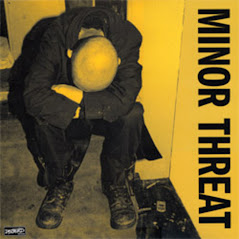
Why an album cover from one of
the most influential hardcore bands
of all time?  Keep reading...
Another fun aspect to the COVID protocols was a set of buttons that we received upon checking.  The buttons were meant to be worn on our conference badge to show our comfort with social distancing.  A green button read "Handshakes & High Fives,", a yellow button read "Elbows OK," and a red button read "Waves Only."  I ended up wearing the green button, but I must say, there were some awkward moments of reaching out to others or others reaching to me and not knowing how to react; strange how two years of not shaking hands, something that I ALWAYS did prior to the pandemic, can become something that you have to learn to do again.  

The conference offered a ton of great sessions, and while I wish I could have attended more, I was able to get to several incredible sessions.  A few of my favorite takeaways from the sessions include:

  • a program in a school from Washington, D.C. that meets with EVERY student starting their junior year to assist in transitioning to life after high school by helping students explore their interests, applying for college, trade schools, internships, jobs, etc., checking in on student progress toward getting to their goal for after high school, and following up with students in the years after high school to see where they ended up
  • a session from a clinical psychologist about the scientific benefits of self-care for educators and students and ways to "put your mask on first"
  • critical race theory (CRT): what it is, what it is not, and how to teach topics deemed to be controversial and sensitive by legislation from states around the country without violating the law
  • tips for white educators on how they can support their historically underserved students by building relationships, leading with empathy, being genuine, and more

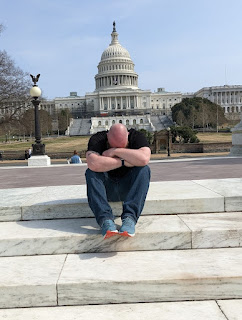
My recreation of Minor Threat!
But this conference was not just about the sessions and the notes I took while listening to the presentations.  It was about meeting new people from all over the country.  It was about getting to know some of my colleagues that I have worked with for the past two years but didn't know much about.  It was about side conversations in the halls between sessions.  It was about the incredible food and drink in the hours after the conference. Or in my case, the days after the conference, as I stayed for an extra two days to take in the city and see the sights that I have always wanted to see and had only read about.  In no particular order, I got to experience the National Mall and monuments like the Vietnam Memorial, Lincoln Memorial, and the Washington Monument, the Library of Congress, Arlington National Cemetary, Ford's Theater, the National Museum of African American History and Culture, the National Museum of the American Indian, the White House, several breweries, and perhaps my best meal (twice) while in the Nation's Capitol, Ben's Chili Bowl (get the banana pudding!).  And just for fun, I made sure to reenact an album cover from Washington D.C.'s own, Minor Threat, while strolling the grounds around the Capitol Building.  

After a few days of reflection on the conference and my time in D.C., I get to look forward to another conference, this time, Spring CUE, in person for the first time since 2019!  I cannot begin to express how excited I am for that one, and because there is so much to talk about it, I'll save it for another post.  

Until next time... 


Friday, November 19, 2021

Is It April Yet?

As I write this, it is mid-November.  The weather in Southern Nevada has been trying to hold onto summer as much as it can.  Temperatures had been hovering in the low 80s still and nights, absolutely gorgeous, in the high 50s or low 60s for most of the month, but days are starting to get a little cooler.  Rain, while desperately needed, has been nearly non-existent.  The first quarter of the school year has come and gone, and we have already completed mid-term progress reports for the second quarter.  "No School November" is upon us, with a four-day weekend for Veterans' Day behind us, then a two-day workweek for the Thanksgiving holiday.  Before long, students will be completing semester exams and we will be on a 2+ week winter holiday break.  

I have always enjoyed long weekends and breaks, but who doesn't?  Sleep can be hard to come by at times during the week and getting a little more of it, even if it means "sleeping in" until after 7:00 AM, is always welcome.  Watching a favorite show on (insert streaming service), binging college football and/or hockey all day, or settling in to watch a movie (Halloween Kills, anyone?) are weekend favorites of mine, as are getting outside for extended walks that are hard to come by during the week, catching up on some yard work or cleaning, or spending the whole day watching over a pork shoulder or beef brisket on the smoker while prepping things like coleslaw, cornbread, baked beans, or any other barbeque favorites.  

This year, those breaks are even more welcome.  I know that I am not the only one that feels this way.  After the uncertainty of the last 20+ months, it's just different than before.  The hours seem longer.  The planning seems more tedious.  The time that used to go into grading is used to put out other fires that seem to pop up more often.  Turning on my computer and putting in work from home was rare before COVID, but now it is nearly non-existent; the last thing that I want to do is stare at a computer screen and do more work once I have walked through the door of my house.  And social media, the place where so many of us go to learn, to interact, to discuss?  I haven't scrolled through Facebook in a month and my time on Instagram and Twitter has diminished significantly.  

Nevada's state flag, showing the Battle Born
nickname and the state flower, the sagebrush
Image courtesy of Wikipedia
If you have been in education for more than a couple of years, there is a distinct feeling of tiredness that comes in the days before spring break, which for most schools comes in March or April.  While the fall semester is filled with days off like Labor Day, Veterans Day, Thanksgiving, and in my home state of Nevada, a personal favorite, Nevada Day that is observed on the last Friday of October to celebrate Nevada's entry into the United States on October 31, 1864 (and because the nation was in the midst of the Civil War, Nevada is nicknamed the Battle Born State).  

The second half of the school year does not have these multiple days off.  Within a week or two of returning from winter break, most schools are off for the Martin Luther King, Jr. holiday.  In February, some schools get a day off for Presidents Day.  But otherwise, most schools do not get any extended weekends or multiple days off to break up the long grind of the second semester.  So by the time that spring break does roll around, people are tired, students and teachers alike, and that week off is welcomed with open arms prior to returning for a few more weeks before final exams and summer break. 

This year, I feel this level of tired in November.  There are mornings where it is a struggle to roll out of bed and get to school.  It is not for a lack of desire to be there, I enjoy the classes that I teach, the kids that I work with on a daily basis, and even though I have a few students on my caseload that are definitely some of the most challenging students I have worked with in my career, it makes each day different and interesting and I couldn't ask for anything else in a career.   

For most of the fall, I was waking up before the sun to get a 3-4 mile walk in before work, something that was as good, if not better, than coffee to perk me up for the day.  Lately, morning walks have been few and far between; that extra hour or so of sleep is more enticing and on a lot of mornings, absolutely needed.  However, exercise is still important and part of my daily routine; November 18th marked my 365th day in a row of some form of exercise, whether it was a walk, a ride on the Peloton, yoga, or one of my two nights of rec league hockey.  

My colleagues are expressing many of the same feelings, so if you are reading this, I can imagine you are in the same boat.  Just know that we are all in this together and like the last almost 2 years, we will get through it and be better for it.  It's hard to frame your mind around it because you are so tired, but take care of yourself, take advantage of the downtime when you have it, and keep doing what you do on a daily basis.  

Until next time...

Saturday, September 18, 2021

The Worst They'll Say Is No!

The school year was winding down, and frankly, it couldn't come more quickly.  The previous 8 months had been mostly online, and if you are an educator and reading this, you know what online teaching was like in the 2020-2021 school year.  I was exhausted and the last thing that I wanted to do was to start thinking about the following school year that would, hopefully, return to in-person learning, albeit with some sort of restrictions due to the COVID-19 pandemic.  But with schedule planning for the following year in full swing and school leaders looking to make some changes to course offerings, my co-teacher and I were thrust into more planning than we had anticipated.  

At the beginning of the 2020-2021 school year, I met the teacher that I would be working with via Google Meet.  We talked a little bit about who we were as educators, expectations for the year, and how we would plan together through a screen.  I also explained that I was asked to co-teach algebra, a subject that hadn't even take as a course in 20 years, let alone ever taught it, but she assured me that regardless of my inexperience in teaching math, we would get through it and learn along the way. 

Over the course of the next few months, we developed a great relationship, realized how well we worked together, which only became better once we returned to part-time in-person teaching in April after 7 months of online teaching. I enjoyed math, for the most part, as a student, but my co-teacher's passion for math was infectious and made me truly love teaching math.  Not bad for someone that last had math, a trigonometry course, in 2001.  

As the school year was winding down, we were both excited and anxious about what the following year would bring us.  We wanted to continue working together, but it is never guaranteed when schedules are created.  We notified school leaders of our desire to work together, but again, we just did not know.  But a bombshell to scheduling created an opportunity for us that we did not see coming.  

For years, my school offered a course titled fundamentals of math for incoming freshman.  This was a class that was assigned to students coming from middle school that had struggled with math over the previous few years in addition to the standard math class for freshman, algebra.  The course would be scheduled on the opposite day of a student's algebra class so that they would have a math class every day.  Once a student passed the fundamentals class, they would earn elective credit toward graduation.  However, it was decided to discontinue the class for the 2021-2022 school year, but my co-teacher and I had an idea...

We knew the benefits of the fundamentals class for so many of our students and were disappointed that the class was eliminated.  We knew that many incoming freshman, especially after nearly a year and a half of online learning, would benefit from an extra math class.  So we came up with a proposal for our principal: why not offer our algebra class as a double block where students would have us every day and allow for us to spend more time with students on algebraic concepts?  And because it would be in the student schedules as two math classes, perhaps they could earn two math credits instead of the one math and one elective credit like the fundamentals of math class did previously.  So we walked over to our principal's office with our plan and hoped she would at least consider it.  

Our principal had questions, naturally.  How would we determine which students should receive the second block?  Would we make the second block class different than the first block in regards to activities, assignments, etc.?  Would a student that did not struggle with math in middle school be a good fit for the class?  Ultimately, we didn't really have answers to these questions and asked our principal what we would need to do to make our idea become reality.  After some brainstorming sessions and a couple of more meetings with our principal, we came up with a final plan:

  • Students would be enrolled in Pre-Algebra and Algebra, two separate course for scheduling purposes, as we could not simply place a student in two sections of Algebra
  • Allow us to evaluate incoming freshman in our classes for the first two weeks of school to decide which students would most benefit from a second math class
  • Students with strong math skills needed to be included as well to serve as peer leaders and to be a positive influence on students that did not have strong skills or confidence in their mathematical skills
  • The Pre-Algebra section would focus primarily on skill building through student collaboration and mathematical stations 
  • Student aides would be assigned to the Pre-Algebra sections that had previously demonstrated strong math skills and could serve as student tutors in class or as leaders of stations on occasion
It was ambitious to say the least.  In my 16 years of education, I had not seen anything like this in any of the schools that I had worked.  And while we had confidence that our principal liked the initial idea, we wondered if this was too ambitious or if was even possible to offer based on district policies.  We didn't have to wait long to get our answer though.  

Before we had even finished pitching our final plan to our principal, she was sold.  Ultimately, she loved the idea of giving students two math credits, getting students the extra help they needed, giving students with strong skills the opportunity to build their leadership skills, and in times of tight budgets, it wasn't going to cost any extra money to make it happen.  The only thing that our principal asked for was that we go out of our way to try outside of the box things with our classes and not simply use the class as a way to do our same lessons from algebra and treat it as extra time.  

Fast forward to this year, about five weeks in, our plan is a work in progress. We created two sections of Pre-Algebra with a wide variety of student skills.  The students selected were evaluated by us in Algebra for two weeks before we had counselors make schedule changes.  We had individual conversations with all students and many of their families about why we believed the second class would be beneficial, and out of the nearly 70 students we talked to, only two decided that they did not want to take the extra class.  In the end, we anticipate that more of students are going to earn the credit, more students are going to appreciate math instead of approaching it as just another class they don't like but have to pass to graduate, and better prepare students for geometry and beyond.  

You may be thinking to yourself, "There is no way that this would ever happen at my school."  My reply?  "How do you know?"  When it comes to any idea that you may have that you believe will benefit student learning, whether it is proposing a second math class, purchasing a site license for a great app, or anything, the absolute worst thing that can happen is that your principal will say no.  I fully understand that some school leaders may be intimidating to approach, which is very unfortunate, but as long as you have a good idea and reasons why it would benefit students, I would venture to guess that most would at least hear you out and now shut you down from the start.  And I am not saying that all ideas are going to be approved, but hopefully you will be given a reason for denial or feedback on how to make your idea better for potential approval in the future.  

Until next time... 

Friday, July 9, 2021

School is Not the Same as Education

A few weeks back, prior to the school year ending for summer break, I was meeting with some colleagues as part of my school's vision team. The vision team is comprised of my school's administration and a handful of teachers and staff to analyze what our school is and what we can do to improve multiple aspects of the school, such as daily attendance, course offerings, pathways to post-secondary education, and training, and much more. Conversations as a group are always enlightening and productive. And my principal loves the Google Meet breakout room feature, so small group conversations are frequent and just as enlightening and productive. However, something mentioned by one of my colleagues during a breakout session really sparked my thinking about something that sounds very simplistic, but it is much more layered and, in my opinion, deserves a little attention.

During a conversation about a variety of topics, most notably a discussion about how to better convey information to students and families about the academic pathways that our school offers or can offer, one of my colleagues said, "School is not the same as education."  He proceeded to explain that the phrases "go to school" and "stay in school" and bantered about, almost without thought, on a regular basis but that both phrases were very simplistic in scope.  What he meant by that was that a student could go to school regularly, earn passing grades and get their diploma, but is that student really prepared for whatever they pursue after high school?  Have we really provided that student with an education, or did that student just "stay in school?"  

This statement really resonated with me.  It's not because I haven't thought about whether students are prepared for life after high school when they graduate.  It resonated with me because with the exception of a handful of schools around the country, or even the world, I don't think we are truly providing students with an education, we are providing them with the opportunity to go to school.  It took my colleague's statement and his insight to really open my mind up to this thought.  Please allow me to explain further...

I have always taught high school, with the exception of a short stint as a middle school administrator, so my frame of mind is in the high school educational model.  When a student comes to high school, they are given a class schedule that includes some, most or all of the following:  English, math, science, social studies, physical education, health, and electives.  Throughout high school, students meet with their counselor periodically to review credits that are based on the requirements for earning their high school diploma; these requirements are based on state, district, and school standards.  But outside of a handful of students, do students really know why they are taking the classes that are required?  Are the classes that are required tailored to a student's preferences and interests for postsecondary education or career paths?  Oftentimes, the answer to these questions is no.  

As a result, schools are failing to fully prepare students for the future. Students don't know what they don't know about what is out there.  If a student wants to go to college, there is plenty of information available to them.  But what most students don't know is the vast amount of training and career options out there that don't require college.  Oftentimes, these "vocational" programs as they used to be called pay students to learn a trade, such as plumbing, and once they have completed the training, pay even more and include excellent benefits.  But while schools should have more information on trade programs and other choices for education and careers that don't require college, why should they stop there?  

Many schools around the country have specifically focused on career and technical education.  In these schools, students are introduced to a career path through classes beginning their freshman year.  Throughout their four years of high school, students complete the requirements needed for their diploma (math, science, English, etc.) and complete courses that will prepare them for further education or a career in their chosen pathway.  

I used to work in a school like this.  We had a variety of programs that students could choose from, including culinary arts, business and marketing, auto technology, building technology, and more.  Over the course of the six years that I taught at this school, I watched students invest themselves in their education.  Why?  Because they were doing something that they WANTED to do.  They weren't placed in electives simply because they had to have an elective.  They chose the electives that they wanted and many found that they really enjoyed learning more about a career pathway that interested them and prepared them for that career when they were done with high school.  Many of my former students walked away with a diploma and were hired into positions in high-end restaurants on the Las Vegas Strip, auto repair shops around the valley, had the upper hand in getting into an apprenticeship program with local construction unions, and much more.  

Many go to college and spend the first couple of years trying to figure out what they want to do for a career.  Sometimes, that leads to students spending more time in college, spending more money, trying to figure it out.  What if these same students had been given the opportunity to explore while in high school through a career pathway such as medical science, had more time with career exploration experts at the school, or got to listen to guest speakers frequently throughout their time in high school?  

We cannot afford to continue to encourage students simply to stay in school.  We need to give students a reason to "stay in school" and provide them with the tools necessary to change staying in school to getting an education and preparing them for their futures.  It will not change overnight and it will most likely start with tough conversations amongst stakeholders in schools and districts, but we risk students falling even further behind if we don't start making changes.  

Until next time... 


Saturday, April 24, 2021

Revisited: #OneWord2021

Each year, ramping up in December and into January, social media is flooded with posts, videos, blogs, etc. proclaiming individuals' one word for the upcoming year. In most years, the exception being 2020, I have also participated in the #OneWord movement. After not choosing a word in 2020, I returned this year, choosing commit as my word to 2021.  Throughout the year, I like to revisit my word and evaluate if the word is still resonating, have I been living up to my choice, and propose and adopt any changes if I need to do so.  

In my original post for #OneWord2021 when selecting commit, I identified some areas in which to firmly commit in 2021 to improve myself as a person and as a professional educator.  Briefly, those areas included committing to exercise, eating better, becoming better informed about issues of equality and equity, becoming a Google Certified Innovator, and overall, just being the best educator that I could be regardless of the model of instruction in which I was teaching.  

As of January when I wrote my original post, I had exercised outside for 43 days in a row. My preferred activity is a walk, usually about 3-4 miles, sometimes further.  Since that writing and as of this writing, my streak is up to 156 days in a row and I have incorporated some additional activities in my days besides walking.  Since the beginning of my streak, I purchased a Peloton bike, and with the exception of 3 days during my spring break, I have completed some sort of activity on the bike or on the app (Peloton isn't just a bike, the app has a variety of walking, running, yoga, cardio, boot camp, and meditation activities as well).  I have started playing hockey again, joining a great group of men and women that play to have fun in a competitive league on Sunday nights on occasion (games are very late on many Sundays, so I don't play every week).  I even bought a skateboard and have been learning how to ride it along with my son who has been wanting to learn himself; my decision to learn to skateboard was my way of spending time with him as he learned to ride.  (I get that at the age of 39, the risks of getting hurt and the time for recovery are higher than if I would have learned as a teenager, but my go-to answer? I wrote a book about risk-taking, so I'm just modeling my own words!) I am able to move around, turn, and balance on the board with relative ease and I am starting to try some basic tricks like an ollie, but I am not expecting to be Tony Hawk anytime soon, so I am most definitely taking my time.  

On January 4, I started actively monitoring my food intake, food choices, and tracking those through Noom.  In addition to helping me track what I am eating and the choices I make, Noom also has lessons built into the program to help me make better decisions, cope with emotions and food (I am definitely an emotional eater, regardless of the emotion), and learn what they call Psych Tricks to help make a healthy diet and lifestyle a part of me and not just a fad diet.  While I still have days where I slip up and make poor decisions, I feel that Noom has helped me become more aware.  I was a Weight Watchers member in the past and while Weight Watchers worked for me at the time, the daily lessons from Noom have helped me to be better committed than the weekly meetings and weigh-ins with WW.  That said, between my commitment to exercise and eating better, I am down over 30 pounds from the beginning of the year.  I still have more weight that I want to lose, but I have more energy, I feel better, and I am definitely seeing results.  Weight isn't coming off as fast as others that are similarly committing to weight loss, but non-scale victories like clothes that fit better are common for me.  Just comparing the two pictures here from late January to mid-April, I can see it in my face and my body.  In addition, I purchased a FitBit smartwatch to help me track steps, exercise, heartrate, sleep, and much more, plus get into some friendly competitions with those that I have connected with on the FitBit app.  

While I have concrete evidence of my commitment to exercise, a healthy diet, and weight loss, evidence of learning more about equality and equity is not as visible.  However, reading, having conversations, and most importantly, listening, have been part of my routine to be a better ally.  I paid close attention to the Derek Chauvin trial and was relieved when a jury found him guilty on all counts in the murder of George Floyd.  And while many proclaimed that justice was served, to me it was more accountability than justice because justice would bring George Floyd back.  And the fight for equality is not over, the verdict is only the start and there is so much work to be done.  And proof of that is in the comment threads on social media and news websites regarding the verdict and the outright hatred and bigotry in those comments, not to mention other incidents that have occurred since George Floyd's murder and even during the time of the trial.  My commitment is to continue to learn, be informed, and listen to help make the world a better place for people of color and end discrimination and bigotry once and for all.  

In the summer of 2020, I submitted a project of the virtual Google Certified Innovator academy but unfortunately, I was not selected.  For 2021, I am hoping to submit again and learn from incredible innovators around the world to help me improve education in my community.  As of this writing, the Innovator cohorts for 2021 have not been announced.  One can assume that they will be virtual again, but perhaps they have not been announced because they are trying to gauge whether an in-person academy can be held later in 2021.  Either way, I am looking forward to the opportunity to try again.  

Lastly, I wanted to commit myself to be the best educator that I could be regardless of the mode of education.  Throughout 2020 and into 2021, my school and district were in full-time distance education.  As things improved, elementary-aged students returned to hybrid instruction in February and eventually were given the choice to return to full-time in-person instruction in early April (my own kids returned to much excitement, especially my son who had never experienced in-person school).  Middle and high school was a little different, with a hybrid schedule proposed but most students remaining in distance education.  I returned in mid-March to work from school and shortly thereafter, having a handful of students in class.  Again, most are still online, so, unfortunately, not much has changed in regards to how lessons are taught.  But for that handful of students that are in person?  It has been game-changing for them!  Students that I rarely interacted with or received any work from are now doing much better just because they are back in person and I can interact with them.  I can better gauge their emotional wellbeing in person and I can have deeper conversations with them about a variety of topics.  While it is still not the "normal" that we knew prior to March 2020, it's a start, and barring any major setbacks, I look forward to full in-person school in August.  

Commit has been a great #OneWord for me thus far.  I look forward to continuing the journey across the board for the remainder of the year. If you chose a word for the year, take a moment to reflect back on it and see if you are still connected to your word of choice and if not, how can you reconnect or even choose another word.  

Until next time... 


Monday, March 22, 2021

The Return to In-Person Instruction

For over a year, COVID-19 has impacted the world in ways that haven't been seen in decades, if ever.  For students and educators in the United States, March 13, 2020, is the generally accepted "last day" of school. Mine was actually March 12, as my school had a four-day weekend for March 13-16. I did not learn that we would not be returning until late Sunday afternoon. But fast forward now to March of 2021 and many schools and districts, including my own, are now returning to at least a partial in-person instruction model, with mixed emotions and reactions.  

What format are you returning to, IF you are going back?

There are a variety of formats depending on the situation for individual schools and districts around the country. Some schools are back to 100% in-person instruction.  Some are returning to a standard schedule with alternating cohorts of students to reduce numbers, with one of the days of the week as a virtual day.  Then there are concurrent hybrid models that involve teaching some students that are in-person while others are at home participating in class virtually.  No model is 100% safe and effective, but it is a sign that things are starting to return to a sense of normalcy.  

And while there are a lot of different approaches to returning, I want to focus on the concurrent hybrid model because this is what my school is returning to for the remainder of the year.  And this focus is only for secondary students; elementary students have a different system. Students and their families that chose to return to hybrid instruction a few weeks back on a district survey were divided into two cohorts.  One cohort would attend school in person on Mondays and Tuesdays, while the other cohort would attend on Thursdays and Fridays.  Wednesdays for all students would be a designated virtual day.  But this is where the return to school becomes confusing and problematic.  

The hybrid model would only be a half-day model.  The first week would allow for grades 6, 9, and 12 to return, with grades 7, 8, 10, and 11 returning with their peers a couple of weeks later after spring break. Students would attend two classes for 90 minutes each in the morning of their designated cohorts.  Virtual students and the other cohort would attend those classes online.  After a two-hour break, all students would get online to attend two more classes for 30 minutes each.  The two-hour break would allow for those students that were at school to get home, have something to eat, and take a break before getting online for their other classes.  

For my school, our "normal" schedule is a four by four block schedule.  Students attend four classes on "odd" day and their other four classes on "even" day.  In the new schedule, Mondays and Thursdays are "odd" days while Tuesdays and Fridays are "even" days.  Over the course of two weeks, students that returned to hybrid would go to each class in-person one time for 90 minutes.  In those two weeks, whether in person or online, students attend each class for a total of 270 minutes or four and a half hours.  Over the course of the remaining weeks of the school year, students would see each teacher in person four times, if they returned to hybrid. 

Now, before I go any further, I do not want to disparage any person or group that was responsible for the planning or the execution of the hybrid plan.  There is no perfect plan to return to and I cannot imagine the time and collaboration that went into planning a safe return to school. However, I do feel that this plan is very flawed in many ways. 

When the survey asking families if they would want to return to a hybrid model was sent, cases of COVID-19 were very high and a safe return would have been very hard to do.  Fast forward a couple of months and the same survey results were used to determine if a student was going to return or remain in distance education.  Families did not have the opportunity to change their mind from virtual to hybrid (if they had chosen hybrid and wanted to stay in distance, they could do that).  As a result, very few students are actually returning to in-person instruction.  

The half-day model is also problematic, in my opinion. Rather than staying at school for a full day, students need to return home to attend two shortened classes. Online classes are hard enough to get started and accomplish things in the time allotted, now 30-minute classes will be done in a snap.  Because of the alternating schedule over two weeks, while students will be on campus for two days a week, they will only see all of their teachers once during that time.  

While many are happy about a return to school, many are also questioning, "Why?", especially with only a few weeks left in the school year.  Many teachers have requested to remain at home to teach remotely due to concerns with a safe return.  Students are not able to get vaccines yet, so families are concern about potential exposure. However, after a few days of working from school without students, then seeing a handful of kids on campus for orientation, it was really nice to see the excitement in their (masked) faces.  

In the end, while I think the system has its problems, I am excited to be back on a school campus with other educators and students.  While it is a far cry from what we used to know, this is a good first step toward getting closer to that sense of normalcy that we have all craved for over a year.  And as cases have steadily decreased in Nevada (the test positivity rate in the state has fallen from a high of nearly 24% in December to under the World Health Organization's recommended rate of 5% as of this writing), I have even more hope that schools will be fully open again come August. 

Until next time...


Wednesday, January 20, 2021

Where Do We Go From Here? Four Years Later...

In the days after the 2016 election, I wrote a blog post titled Where Do We Go From Here?, a commentary about the runup to the election and the results.  At the time, I was very disillusioned by the negativity of the campaign in the months prior to the election and while I was not at all pleased with the results, I wrote about keeping an open mind and hoping that the Constitution's system of checks and balances would result in limiting any drastic changes to policies in the years under a Trump presidency. And while I had full intentions to write this in a more timely fashion, the developments were moving so fast that anything I wrote would have been obsolete the moment I published it, and that may still be the case! In a review of this post four years later, so much has changed, but at the same time, not much has changed at all.  

Four years under Donald Trump has made us more divided than ever.  Issues that should not be politicized, such as racial equality, scientific evidence, and denouncement of hate and domestic terror groups, have divided much of the nation into distinct camps.  Trump and his supporters have made bigots of many kinds comfortable to spew their hatred and misinformation like wildfire.  He has sown distrust for credible media sources, teachers, doctors, scientists, and essentially anybody that does not agree with his agenda.  And a pandemic that has been raging for months? Don't get me started on that...

To top it off, weeks after the elections and after the results of the election were called by major media outlets (across the political spectrum, mind you) and vote certifications underway, he refused to concede defeat and has filed lawsuits that claim rampant voter fraud without evidence, nearly all of which have been tossed out.  Supporters continued to feed into the misinformation and other leaders within the party that has the ability to denounce it have enabled him even further.  Then, the unfathomable happened: a sitting president encouraged a violent uprising in protest to the certification of the Electoral College results, leading to hundreds, even thousands, storming the Capitol in an attempted coup.  If you would have told me in January 2017 that this would have happened, I would have thought you were writing a movie script. 

As a historian, I can think of countless comparisons of leaders that did these exact kinds of things in dictatorships where misinformation, distrust, and questioning of legitimate election results have plagued nations and lead to outbreaks of violence and worldwide wars. But in the United States of America?  The nation that is supposed to be the beacon of democratic principles across the globe?  And to have an armed mob storm the Capitol, nearly without resistance, is something that you see on the news that "happens someplace else." (I recently watched both seasons of Jack Ryan on Amazon Prime and found it very chilling to watch people storming the presidential palace after a contentious election in Venezuala, events that are not true, but very realistic looking on the show.)  Whether the security for the Capitol on January 6 was that ill-prepared or in cahoots with those responsible remains to be seen, but to have it be the first time that the Capitol had been breached since the British stormed Washington, DC in the War of 1812?  I'll let you reflect on that... 

Now that President Biden's inauguration is behind us, I have been overcome with a sense of relief.  Not because things are going to change instantly and life is going to be "normal" again, but because of a lot of different reasons.  I am relieved and excited that the new president is somebody that is not going to go out of their way to be divisive in their words and actions (politically, one may not agree with him, but let's face it, Joe Biden is not going to take to Twitter to belittle people and fire them from their jobs).  I am relieved that the new president is surrounding himself with competent, intelligent people that have experience in their fields, not simply appointing friends and supporters like the spoils system of decades ago.  I am relieved that the various government agencies are working diligently to bring those responsible for the insurrection of January 6 to justice, as arrests and charges are filed on a daily basis.  And I am relieved that the problems that were brought into the open further by the previous four years can be addressed and work can begin to solve them.  

This is not going to happen overnight.  When the Allies defeated Nazi Germany in 1945, Nazism did not simply disappear.  It took years for war criminals to be brought to justice and the effects that fascism had on German society to be eradicated, but even then, it wasn't eradicated completely.  Is it fair to compare Trumpism to Nazism?  Perhaps not, it is comparing apples to oranges, but many aspects are very similar, such as the disinformation campaigns, attempting to ignore legitimate elections, and the refusal to denounce xenophobia, racism, and white nationalism in the ranks of supporters.  And this is not to compare all Trump supporters to those groups, but this country has, for far too long, ignored problems in the name of supporting a party or ideology, i.e. supporting law enforcement but turning a blind eye to systemic racism in policing. 

And what does this mean for education?  For starters, an educator, Miguel Cardona, will be leading the Department of Education, not a billionaire hellbent on destroying public education and helping for-profit schools line their pockets.  There has already been discussion of forgiving student loan debt to help people get out of that debt and stimulate the economy (imagine where people that normally spend $500/month on student loans can put that money!), but with slim majorities in the House and Senate, it may be tough to pass large scale forgiveness.  But perhaps the most important aspect of turning the page?  It is even more apparent how important educators' jobs are to help mold informed citizens.  Even after Biden's inauguration, there is still a large percentage of people that feel that the election was stolen and rigged, all because they were fed lies by the president and relied on QAnon and far-right "media" sources for their information.  Teaching students how to analyze sources and determine if a source has a credible reputation (ex. Associated Press, Reuters, etc.) is going to be the catalyst moving forward for limiting disinformation from our lives.  

As I mentioned, I was not excited for a Trump presidency in late 2016 and 2017.  I kept an open mind but was sorely disappointed in those four years.  And while I do not expect Joe Biden to be a miracle worker that will go down as the greatest president of all time, I do have hope for the next four years simply based on common decency and the decisions that he has made leading up to the start of his term, most notably, naming Kamala Harris the first-ever female vice president!  We may not agree politically, but I look forward to the coming weeks of productive discourse without fear of reprimand from the Oval Office's personal Twitter account.  

Until next time... 

Tuesday, January 5, 2021

#OneWord2021: Commit

The air was crisp, deceiving considering the bright sunshine and the wide blue skies.  A slight but steady breeze cut into me, forcing me to zip up my sweatshirt and pull the hood up over my ears.  The only sound was the crunch of rocks beneath my feet. I strained to hear other sounds, hoping for something out of the ordinary, after all, this was a ghost town.  Even though I couldn't hear anything, another strange sensation overcame me; it was almost as if I could feel the presence of those that were here before me, over a hundred years prior.  

Devil's Golf Course, Death Valley National Park
I had been to Rhyolite before, but this was the first time that I truly had the opportunity to explore the ruins of the former gold mining town.  Located about 120 miles from Las Vegas, Rhyolite was a boomtown in the early 1900s after gold was discovered but quickly depleted.  A town that is estimated to have been as large as 8,000 people disappeared by 1920.  A quiet New Year's Day walk around what was left of Rhyolite was a great way to kick off 2021, followed shortly by a drive to Death Valley and a handful of short hikes along Artist's Drive, Devil's Golf Course, and the salt flats of Badwater Basin.  The day was a great way to continue my daily exercise routine, marking 43 days in a row of getting outside, mainly walking 3-5 miles a day.  

After the turmoil of 2020 and everything that came with it, it would be very easy to go through the motions or even give up on things.  And in all honesty, I did that with many aspects of my life, personally and professionally.  As remote teaching and learning, or more appropriately, emergency teaching and learning, progressed in the spring, it became harder and harder each day to commit myself 100% to my craft.  After a strong start to getting outside and walking or riding my bike in the spring, I made more excuses that I made commitments to stick to the routine, especially after my move and the heat of the Mojave Desert intensified in the summer months.  Rather than writing and reflecting on a regular basis, I got away from this blog for weeks at a time, did not interact as much on social media, and spent less time participating in professional development (I even spent money on a virtual conference that I DID NOT attend because I simply "did not feel like it").  

As the calendar approached the new year, I began to think about goals for 2021 and a return to One Word.  For reasons that I cannot quite pinpoint or remember, I did not choose a word for 2020 and did not write a blog looking ahead to 2020.  The closest I came to any sort of looking ahead was refusing to predict the future in my end of the year reflection piece from late 2019, The Closing of a Decade: 2010-2019. I am not so pompous to suggest that 2020 turned into the proverbial dumpster fire because I did not choose a word, but if you want to blame somebody, I'll fall on the sword for you.  

Circling back to the start of the new year at Rhyolite and Death Valley, I mentioned that January 1st marked 43 days in a row of exercise and getting outside.  It marked substantial commitment on my part, one that has continued through this writing.  Even when I was younger and playing sports, including four years of football in college, I don't think I had ever exercised that many days in a row.  Rest days were rest days where I did not do anything.  That said, for 2021, I have selected COMMIT as my One Word.  Basically, I want to own the things I say and the commitments that I make and follow through each and every time.  But it's more than just a continuation of my exercise streak:

  1. Take my streak one day at a time.  I am not committing to 365 straight days of exercise, but each morning, I can commit to working out that day.  Even if it is just a short walk, a short walk is better than not getting off of the couch at all!  I know that at one point, the streak will end, but as long as I am physically able to continue my streak, I will do it!
  2. I have struggled with my weight for a long time.  I have always been big, but at least in high school and college, I was more fit and toned.  My wake-up call came on Sunday, January 3 when I stepped on the scale for the first time in probably eight months.  For the first time in my life, I weighed in at over 300 pounds.  No matter my muscle mass and excuses that I have made in that regard, that kind of weight is not healthy for a person with a family history like mine.  And while I have a goal weight in mind, like my exercise commitment, I am committing myself to one day at a time of eating better, making better choices, and holding myself accountable to make a permanent change to my weight and my health.  
  3. 2020 has brought to light issues that have always been there and have needed to be addressed for hundreds of years: equality for all and educational equity.  I will be the first to admit as a white male that I have a lot to learn and more that I can do to become an antiracist educator and advocate for educational equity.  I am committing myself to learn more, not shy away from tough conversations, and be more of an ally for all that are unfairly disadvantaged.  
  4. In 2020, I applied for the Google Innovator Academy and unfortunately, was rejected.  While I believe that my initial application included a solid idea, I know that there are thousands of people that also have solid ideas, and competition for that coveted Innovator certification is fierce.  I am committing myself to evaluate my ideas, polish the application, and hopefully, earn the opportunity to participate in the Innovator Academy in 2021.  
  5. Lastly, the first half of the 2020-2021 school year was a tough one, completely online.  And while we are starting the new semester virtually once again, regardless of how the remainder of the school year and beyond plays out, I commit to being the best educator that I can be for each one of my students, their families, and my colleagues.  
What is your One Word for 2021?  What goals do you have for this year?  How do you intend to meet your goals?  What do you perceive as possible barriers to achieving your goals?  Think about it...

Until next time...